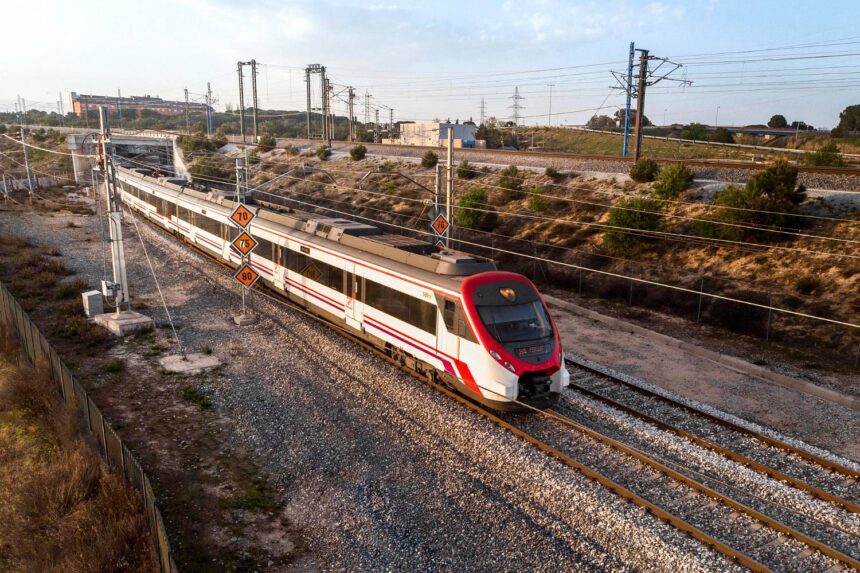

The costs of corrosion affecting fasteners and elastic components in railway infrastructure—caused by harsh weather conditions, continuous vibrations, and an aggressive chemical environment—generate massive financial burdens for rolling stock companies and track operators.
Zinc flake coating is a non-electrolytic metal finishing method that utilizes parallel micro-flakes of zinc and aluminum to form an advanced, thin anti-corrosion barrier. It has become an imperative standard in demanding industrial applications.
Choosing the right protective technology is critical to maintaining operational continuity and reducing Total Cost of Ownership (TCO). As demonstrated by tests and our projects detailed on Metalpol, innovative flake coatings allow maintenance engineers to optimize their operations. In this article, based on a specific implementation, we explain how zinc flake coating lowers servicing costs while strictly adhering to rigorous railway and automotive industry standards.
Dual Technological Shield – Barrier Effect and Cathodic Protection
The structure of a flake coating acts on a steel part like a high-tech “scaled armor.” Parallel micro-flakes of zinc and aluminum overlap extremely tightly (like tiles on a roof), creating a complex geometric labyrinth for environmental factors.
Moisture, oxygen, and road salt cannot penetrate this physical barrier to reach the steel base. By comparison, traditional electrogalvanizing creates a single, porous layer that is far more susceptible to microcracks. Beyond providing an exceptional physical barrier, zinc flake coating delivers active cathodic protection. In the event of localized mechanical damage—such as an impact from track ballast—zinc (being a less noble metal than iron) oxidizes first. This means the coating “sacrifices” itself, actively protecting the underlying steel substrate from progressive red rust.
Elimination of Hydrogen Embrittlement in Strength Classes 10.9 and 12.9
For design and quality engineers, the complete elimination of Hydrogen Embrittlement (HE) risk is of fundamental importance. Traditional electrogalvanizing processes require initial acid pickling and the application of an electric current, which causes free hydrogen atoms to penetrate the crystalline structure of the steel.
In high-carbon steel components—such as specialized compression springs or high-strength bolts in property classes 8.8, 10.9, and 12.9—the presence of hydrogen causes sudden, catastrophic delayed cracking under operational stress.
Flake technology is a completely non-electrolytic process. It relies solely on mechanical surface preparation (precise shot blasting), avoiding aggressive acid pickling altogether. Consequently, it 100% eliminates the risk of hydrogen embrittlement, complying with the strict engineering guidelines set out in the international standard ISO 10683.
Ideal Dimensional Tolerances Without Oversizing
Procurement departments also benefit from the thin-layer nature of this solution. A zinc flake coating measuring only 5–15 µm in thickness guarantees ideal thread tolerance preservation and leaves the operational geometry of spring coils intact. Unlike Hot-Dip Galvanizing (HDG), which produces irregular coating buildups of 50–80 µm, flake technology allows for direct component assembly. This removes the need for additional, costly thread re-tapping or mechanical cleaning prior to installation on the trackbed.
How Railway Infrastructure Service Windows Were Reduced by 70%
The following example illustrates the financial difference that choosing the correct coating makes for railway infrastructure.
-
Diagnosed Problem: Turnout fastening bolts and elastic mechanisms in signaling systems located along a high-humidity route suffered severe pitting corrosion after just 18 months. This resulted in seized joints, forcing the scheduling of extremely expensive night service windows. During these interventions, technicians had to cut seized bolts with torches, sending entire fastener sets to scrap prematurely.
-
Implemented Solution: Traditionally protected fasteners were replaced with zinc flake-coated components. The coating was applied using precision dip-spin coating technology on automated production lines at Metalpol’s facilities. The applied system guaranteed superior performance in rigorous salt spray testing (NSS > 720h).
-
Result: Field inspections showed zero traces of red rust after more than 4 years of continuous, heavy-duty operation. The infrastructure manager recorded a 70% reduction in direct maintenance costs across the monitored section. Disassembly during routine inspections was non-invasive, preserving the threads, while the fasteners maintained a stable coefficient of friction and optimal clamping forces.
Comparison: Coating Technologies
|
Evaluated Parameter |
Electrogalvanizing (Fe/Zn) |
Hot-Dip Galvanizing (HDG) |
Zinc Flake Coating |
|
Risk of Hydrogen Embrittlement |
High (requires baking) |
Medium |
None (0%) |
|
Impact on Dimensional Tolerances |
Moderate |
Very Invasive (clogs threads) |
Neutral (5–15 µm thickness) |
|
Salt Spray Resistance (NSS) |
~96h – 240h |
~480h – 700h |
> 720h (up to 1000h+) |
Summary and Conclusions
Selecting a zinc flake coating for fasteners and springs used in the railway industry is no longer just an “interesting technological alternative”—it has become an indisputable optimization requirement. The complete elimination of hydrogen embrittlement ensures operational safety for high-strength components, while exceptional corrosion resistance directly cuts the costs of recurring maintenance interventions.